Wednesday, 15 June 2011

The Wallabies’ Achilles Heel


With the regular season drawing to a close, it’s that time of year when coaches pick their train-on squads and scribes pick their prefered national teams. The selection of this year’s Wallabies should be relatively straightforward with most positions having one or two obvious stand-outs. 

With the likes of Quade Cooper, Genia, Beale, and O’Connor,  the Wallabies will field one of the most exciting backlines in the world.

Australia also have two of international rugby's best hookers in Moore and Polota-Nau, and the team should hold its own in the second row and loose forwards.


However, for over a decade one position has been Australia’s achilles heel: the tighthead prop. 


This blogger recalls that a pressing need to develop Australia’s front row stocks was elucidated by Eddie Jones as far back as 2003, yet here we are two World Cups later still having failed to produce a single world class tighthead. With such a small player base in Australian rugby, perhaps this should not be overly surprising. But there are enough kids of suitable body size in Australia to suggest that either the ARU’s talent scouts or the development pathway have failed.

After the fly-half, the tighthead prop is the next most important player in the team, for he is the anchorman.

It doesn’t matter how good the backline is, if the scrum can't hold its own, the team will concede penalties and the backs will receive poor ball.

The Wallabies have several good looseheads, but although shuffling props from one side of the scrum to the other is often adequate at provincial level, it is questionable whether a makeshift tighthead would be able to stand up to the working over expected from the All Blacks, Springboks, or England.


Suggested Wallaby team:

1 Robinson
2 Polota-Nau 
Kepu or Daley
4 Horwill
5 Sharpe
6 Elsom
7 Pocock
8 Samo 
9 Genia
10 Cooper
11 Ioane
12 Giteau
13 Fainga'a
14 O’Connor
15 Beale 

Wednesday, 1 June 2011

The Away Goals Rule

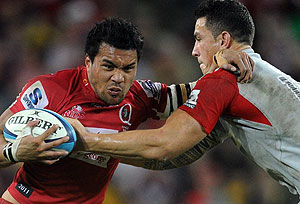
Last weekend’s Crusaders-Reds game lived up to the pre-game hype. It had test match intensity from start to finish dominated by ferocious defense, hand-to-hand combat between the forwards, touches of brilliance from Quade Cooper, and hard running from both teams.


Unlike some referees who seem to be under the impression that they are the evening’s main attraction, by underplaying his hand for much of the game Stu Dickinson allowed a free-flowing contest.

But with two minutes to go, as the Reds drove into position in front of the sticks,  the Crusaders’ captain  made a fateful decision to crash through the Reds' ruck. He gambled that Dickinson would interpret the rules in his favour, and lost. It was a throw of the dice that cost his side the game.

The Reds scored two tries to one, so at least by this statistic, they were the deserved winners.

However, your blogger counted nine Reds’ passes (most of them thrown by Genia) that were marginal enough to have been called forward, and three Reds’ offside plays, none of which were called by the referee. The Crusaders’, by comparison, threw only one marginal pass that wasn’t called. In Dickinson’s favor, the discrepancy could be explained in part because the Reds’ played with a very flat offense, such that players constantly received the ball close to the gain line.

The Reds will need to watch this, because when playing away from home, it is unlikely that referees will interpret such flirtation with the rules so favorably. Just like the players, referees are influenced by the crowd, resulting in a tendency to make decisions that favor the home team. In SuperRugby, and even more so in the Tri-Nations, the result of most games goes the way of the home side.

Soccer (dare I call it football), has long recognised this phenomenon, and has attempted to counter it with the “away goals rule”. In the event of scores being equal after a home and away leg, the winner is the team that has scored the most goals away from home.

In other words, away goals count double.

SuperRugby and the Tri-Nations should introduce something similar by awarding more points for an away win than for a win at home. 


Friday, 27 May 2011

Hybrid Rugby

I have a confession to make: I like it both ways. Despite preferring the 15-a-side game, I am also a supporter of my local rugby league team: St.George-Illawarra Dragons, the reigning NRL premiers. 


In contrast to the muted ambience at Waratahs games, when you're dressed in red and white in the midst of the Dragon Army the atmosphere is intoxicating, the cameraderie overwhelming. The difference boils down to demographics: Dragons fans are blue collar, while 'Tahs games are attended by the gentry. 

Due to the disappointing standard of local SuperRugby games this week (the Reds had a bye), the entertainment highlight was provided by league's State Of Origin game. It was a typically brutal stoush, complete with post-match pugilism. The QLD combination of Lockyer, Thurston, and Slater showed once again that creatively they have no equal, coming from behind to clinch the game with a classically worked try. 


Aussie rugby union could do with players like that. 


SuperRugby's Australian conference has degenerated into a lop-sided farce because, although the ARU has created five SuperRugby franchises, there aren't enough union players of sufficient quality to ensure that more than one or two teams are competitive. The Reds are superb, the 'Tahs are disappointing, and the rest are rubbish.


The dearth of quality players owes to the fact that the ARU, which represents the elitist upper class of Australian society (private school old boys), has never made any attempt to spread the grass roots of rugby to the masses. This has not happened by chance; throughout the history of the game there has been an unspoken policy that rugby union should remain a game for the privileged.

No wonder concerned individuals are promoting a union-league hybrid game: Read the description of the game here.

With no grass roots of note, the cross-pollination of the code with league players is the only hope Australian rugby has of achieving consistent success at international level.


Unfortunately, league’s popularity in Australia has now marched so far ahead of union that the NRL is in no hurry to co-operate. Still, this blogger lives in hope that one day the schism will finally come to an end. With News Ltd reportedly lending its support to a hybrid game, perhaps it is not as far-fetched as some might think.


Sunday, 15 May 2011

Only One Team To Watch In Australian Rugby

By only watching Reds games, Australian fans can save themselves a lot  of wasted time in front of the box each weekend, because the rugby played by the other Australian franchises is woeful.

The Waratahs, contributing a quarter of the weekly rubbish dished up by Australian sides, play like a limbless torso floundering around in the SFS mud, expending much energy for naught. Empty seats are increasing exponentially with every home game, while the bright idea of a forum inviting public criticism only serves to call attention to their clueless administration.

Williams, Kennedy, Dwyer, McKenzie, Hickey……. over the years the coaches have come and gone, but the song remains the same. Unless the franchise is taken away from the incompetent NSWRU and handed to a consortium of private enterprise, the tale of Sydney's boring under-achievers will continue.

Things aren't much better to the south and west, from where the remaining 75% of uninspiring rugby originates. Since being labeled rugby’s Real Madrid, the Brumbies have been a major disappointment, every week sinking deeper into the abyss. They are a team miserably playing out time while awaiting the arrival next year of their anointed saviour,  Jake White.

Further south, Danny Cipriani has driven a stake through the heart of the Rebels, leaving them spiritless, rudderless, and their debut season in tatters.

Across the Nullabor, the Force are a franchise that has been transplanted too far from rugby's roots to ever reach any heights in this competition.

The Reds are the only Australian team worth watching. Genia has claims on the title of world’s best halfback. Cooper, when on song,  has the magician's sleight of hand. Samo, Higginbotham and Ioane are powerful and inspiring players who get the team on the front foot. Queensland have self-belief, there's depth in the squad, and they are astutely coached.

After a bye, the Crusaders will be the Reds next opponent.  Despite the Saders' loss last weekend, the Twickenham game showed that the combination of Dan Carter and Sonny Bill Williams (who could be the player of the tournament in this year's world cup) can be almost unstoppable. 


The Reds, however, will have the home ground advantage, in front of 30,000 roaring fans. It should be a cracker!


Monday, 9 May 2011

Cipriani Derails Rebels’ Season


Team morale is a precious commodity. Once lost, the wheels inevitably fall off.

And so the Rebels’ season has gone. Despite inconsistency, early season performances had marked them as a dangerous proposition at home, disposing of the Hurricanes and Brumbies before narrowly going down to the Sharks. They followed this with a thrilling win over the Force in Perth, proving they could re-produce the same form away from the cauldron known as The Stockade.

As time went on, however,  it became increasingly clear that all was not well in the Rebels camp. The player with the number 10 on his back -- the most important member of the team-- was repeatedly in trouble for late night drinking escapades. Coinciding with this, Cipriani’s defense started to resemble a revolving door. Against the Highlanders, while the rest of the team busted their guts,  his laughable attempts at tackling led to three tries which gifted the North Island team the game.

Clearly Cipriani has an attitude problem. There is the suspicion that he is an outright alcoholic. With the entire Rebels game plan dependent on him, he has not only let himself down, but he has let down his teammates, Rebels fans, and the coach and club who were prepared to give someone of dubious reputation a chance at redemption. 

Blessed with prodigious talent, Cipriani doesn’t have the ticker for rugby. You can bet he won’t be in Melbourne next season, and it’s hard to imagine any other club signing such a liability.


Monday, 4 April 2011

More Than Studs And Leather

Is it sport, or is it a party?  Some go to watch rugby, others go to party, and those like yours truly enjoyed both. 


Yes, we’re talking about the one and only Hong Kong Sevens, the world’s biggest rugby party.


Perhaps the Saturday is more for party-goers, and the Sunday for rugby aficionados, but it all becomes somewhat blurry after a while.


Sevens rugby is not everyone’s cup of tea. There is something inherently  light-hearted about it, perhaps more akin to a game that you’d expect to see in the backyard after a barbecue, or in the school playground at lunchtime. But it does indeed grow on you, and the fitness and skill levels are unquestionably  high.


It is also the only form of rugby which is truly competitive world-wide, with teams from countries such as Canada, Portugal, Spain, and Russia performing very creditably.


Anyway, here’s a few pictures intended to capture the atmosphere at the Hong Kong 7’s, 2011, courtesy of Steve Lawie.

 The clergy got into the spirit of things.


Mr. T was there.


Team America took time out from saving the world.


 Support for the Kazakhstan team.


He claimed the Welsh are the “Reigning World champions”, but was it a load of bull? 


?


Miss Bubbles


Spongebobs


Fred


Duty, Honour, Country.


The fairest of them all. 


Sunday, 3 April 2011

The Dawning Of A New Era

Anyone watching the awesome performance of the Indian cricket team in the World Cup could only have been impressed by the quality of cricket on display. But demographics indicate that we are witnessing something even greater: India will dominate international cricket for decades to come.


With around 160,000 registered adult players,  the cricket participation rate in Australia is less than 2% of the population.

Despite being a sports-mad nation, our enthusiasm is divided amongst many codes.

The population of India is fifty times that of Australia, and the cricket participation rate is conservatively listed at 5% of its population, so the ratio of cricket players in India to Australia is more than 100:1.

Obsessed with only one sport, India has a gargantuan pool of players to draw on.

Formerly, India’s rise to the top of world cricket had been prevented by poverty, but it now has one of the fastest economic growth rates in the world.

While per capita income growth in Australia is around 2%, the per capita income in India is expected to double within the next 9 years.

This will rapidly result in progressively more of its population entering a burgeoning middle class, with the income to indulge in a game which is a national obsession.

The sheer weight of numbers is compelling: it is the dawning of a new era.